Friday, January 22, 2016

pGLO lab

pGLO Observations , Data Recording & Analysis
1.
Obtain your team plates.  Observe your set of  “+pGLO” plates under room light and with UV light.  Record numbers of colonies and color of colonies. Fill in the table below.
Plate
Number of Colonies
Color of colonies under room light
Color of colonies under   UV light
- pGLO LB
0
none
none
- pGLO LB/amp
0
none
none
+ pGLO LB/amp
6
none
purplish white
+ pGLO LB/amp/ara
2
none
greenish white

2.
What two new traits do your transformed bacteria have?
Each got the plasmid and the bacteria they also create a colony and they were green when you flash the fluorescent light on it.
3.
Estimate how many bacteria were in the 100 uL of bacteria that you spread on each plate. Explain your logic.

We were spreading from one  bacteria to the petri dish.
4.
What is the role of arabinose in the plates?
It got the plasmid to glow green that was protein plasmid that grew in  all of the colonies in the petri dish.
5.
List and briefly explain three current uses for GFP (green fluorescent protein) in research or applied science.
One use is to use green fluorescent protein as an indicator to see if the organism got another desired trait. Another use for green fluorescent protein in animals as protection. Another use for green fluorescent protein is glow sticks.
6.
Give an example of another application of genetic engineering.
              Seed Companies genetically seeds so that they are resistant diseases and pesticides.


Thursday, January 21, 2016

Candy Electrophoresis Lab


Candy Electrophoresis Lab

1. They all were the same color as the reference dyes.a.Yes, the yellow band faded more than the reference band.
b.The blue reference faded more than the reference.
c.In the yellow candy band, we started to get a slight shade of blue.
d.blue and yellow moved towards the cathode.
These dyes were probably artificial dyes, the same as the reference dyes, as they all moved similarly as the reference dyes.

2.Dyes that moves towards a positive charge are usually artificial dyes. The yellow and the blue dyes moved in an opposite direction towards the negative charge. All of the reference dyes moved from the wells. Fast green FCF and citrus red 2 would move in a similar direction because they are artificial.

3. They used artificial colors in dog food to preserve the nutrients and to make the food look like food that is appetizing to dogs.

4. One reason why artificial food coloring is preferable to natural food coloring is that artificial food coloring lasts longer and might be cheaper to produce.

FD&C Dye
Color
Natural Alternative
Source of Natural Dye
FD&C Blue 1
Blue
Natural Blue Dye
vegetable juice
FD&C Green  3
Green
Natural Green Dye
spinach
FD&C Red 3,
Red
Natural Red Dye
beet juice
FD&C Yellow  5
Yellow
Natural Yellow Dye
turmeric

5.What two factors control the distance the colored dye solutions migrate?
  1. Charge of the dye
  2. the size of the dye
         

6.The force that helps move the dyes through the gel is the electrical current which drives the  force of attraction between negative charges and positive charges ( the negatively charged dyes are pulled towards the positive cathode and the positively charged dyes move towards the negative cathode).

7.The electrical current of the electrophoresis system  causes the molecules to move by charge and the gelatin that the molecule is put in causes the molecules to separate by size. The electric current makes the molecule move but the smaller the molecule is faster it can move through the gel compared to the bigger molecules. That is how they are separated by size.


8. The DNA molecules would separate by size with the lightest DNA molecule to travel the most distance ( 600). The way they separate in the order of the largest distance to the shortest distance is 600, 1000,2000, and 5,000 daltons.

Wednesday, January 13, 2016

Recombinant DNA lab

In this lab, we learned about recombinant DNA. It would provide resistant to Kanamycin resistance for antibiotics would this plasmid provide resistance would be important. I think antibiotic resistance would be important because it help protect from harmful diseases. I didn't use Ava II and Hin dIII, Bam HI, Bgl II, Hpa II,  Sac I, Xma I and Asp II and LIGASE because it doesn't work because each different restriction enzyme. The 3 antibiotic were tetracycline, kanamycin, and ampicillin in each trial I had to be aware of whether these are resistant. The one we used was Eco RI because it was the closest.


Tuesday, January 5, 2016

New Year's Goal

1. I will complete my 20% time project in Biology. I will write out the scientific method for completing the 20% time project. I will research Tesla Motors and electric powered engines.

2. I will become a eagle scout before I graduate from high school.


I am currently First Class in Boy Scouts.

Thursday, December 10, 2015

Unit 5 Reflection

The unit was about different types mutations like point mutation and the frameshift mutation. Also, I learned was the substitution, translation, and translocation. In this unit, I also learned about gene expression and regulation and Eukaryotic Regulation. The genetic code, walking the dogma, central walking dogma was also learned in this unit.

I learned that mutations are a change in the DNA code. I also learned that anything that causes a mutation. I learned about point mutation are a change in one or two base pairs of DNA. In frameshift mutation, there are 2 types insertion and deletion. Insertion is an extra base pair is put in the code. Deletion is a base pair is left out of the code. In other mutations, the inversion DNA breaks off and bonds in reverse order.

In gene expression, every cell in your body has the same DNA but not all cells look the same. Also, gene regulation is cells don't want to waste energy or overexpress genes, thus have a variety of steps used to control gene expression. 

Eukaryotic Regulation is also I learned about. It involves with Exons and Introns. After transcription sections of the gene are removed. Several proteins will bind before a gene and are required for the gene to be expressed. It needs more complex than bacterial regulation.

In the DNA Extraction Lab, I actually saw my own DNA. I found it interesting to see my own DNA.


Tuesday, December 8, 2015

Protein Synthesis Lab

1. The enzyme attaches to a piece of DNA called a gene.  The enzyme makes the copy of the DNA called mRNA. The mRNA goes out of the nucleus. The mRNA bonds with the ribosome. The ribosome reads the mRNA sequence and its codons. The codon correspond to a certain amino acid. Amino Acids are added together by the ribosome.  When the mRNA is finished the amino acids that are added together make a protein.

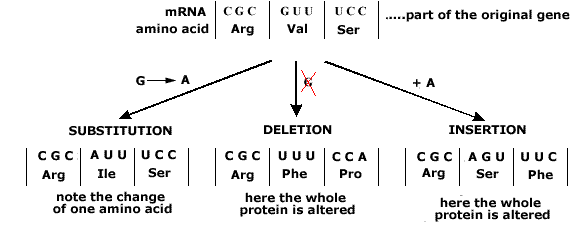
2.  The mutations that have the greatest effect are deletion and insertions. The mutation that has the least effect is a substitution.  The deletion and insertion  mutations have a bigger effect when it is near the beginning of the sequence because all the codons after the mutation will be affected.

3. In step 5 I deleted the first base pair because I believe it would cause the greatest change. There would be no start codon so the protein won't start where it usually does. Also, all of the codons afterwards would change  and make different amino acids. Since the mutation occurred in the beginning of the sequence,   the protein is changed more than if the mutation was at the end. If the mutation was at the end then not as many codons would be affected. 

4. Ectrodactyly is a disorder where humans have a cleft where the middle finger or the middle toe should be. As the result, the hands or feet look like claws. This caused by deletions in chromosome 7.

Friday, December 4, 2015

DNA Extraction Lab

In this lab we separated DNA from cheek cells in order to study it. I found the homogenization, lysis, and precipitation results in seeing my DNA.  First I swished the Gatorade in my mouth the Gatorade was the polar liquid. This was the homogenization stage. Next was the lysis stage. In this phase, I put soap and salt in order to emulsify the lipids and proteins of the cell. We further broke it down to the histones. Before the precipitation stage, we added the catabolic proteases which were pineapple juice breaks protein called histone. In the last stage, we added alcohol. The alcohol is nonpolar and polar is the mixture was on the bottom. I could see my DNA where the two mixtures came together.

My hypothesis was supports because in the nonpolar liquid we could see the DNA isolated because the DNA molecule was polar. While our hypothesis was supported by our data there could have been errors due to the group  doing the steps out of order. We could have added too much soap. We could have added too much pineapple juice.